

How to Identify Solid Wood Furniture Before You Buy
Last Updated: November 24, 2026
Quick Summary
You can tell furniture is solid wood by checking whether the grain runs continuously across the top and over the edge, looking at the end grain on any exposed cut, and examining the underside for a repeating pattern. Solid wood furniture is built from planks cut from a single piece of timber, so every surface shows that board's grain.
- On a solid board, grain lines bend and continue around the corner because the top and side are the same piece.
- Real wood shows natural variation no factory can fake convincingly: knots, color shifts, and slight differences in grain density.
- Solid wood looks the same underneath as on top, while laminate and particleboard often show a raw, speckled core.
- Solid oak or mango is heavy and cold to the touch; MDF and particleboard feel lighter and warmer.
- Buy solid wood for anything you sit on, eat at, or expect to keep for a decade.
Table of Contents
- How can you tell if furniture is solid wood?
- Solid wood vs veneer: what the edges reveal
- How to tell if furniture is real wood versus a lookalike
- Engineered wood vs solid wood furniture: reading the core
- Frequently Asked Questions
How can you tell if furniture is solid wood?
You can tell furniture is solid wood by checking whether the grain runs continuously across the top and over the edge, looking at the end grain on any exposed cut, and examining the underside for a repeating pattern. Start with those three checks before touching the price tag.
Solid wood furniture is built from planks cut from a single piece of timber, so every surface shows that board's grain.
- Top and edge: grain should wrap around, not stop dead
- End grain: visible growth rings on an unfinished cut
- Underside: no repeating printed pattern
- Weight: solid oak and mango feel dense and cold
Most furniture sold today is not solid wood all the way through. Many pieces use a solid frame with a veneered panel, which is legitimate, the trick is knowing which parts are which.
Solid wood vs veneer: what the edges reveal
The edge is where veneer gives itself away. On a solid board, grain lines bend and continue around the corner because the top and side are the same piece. On a veneered top, the flat surface's grain stops at the edge, and the edge strip shows a different pattern.
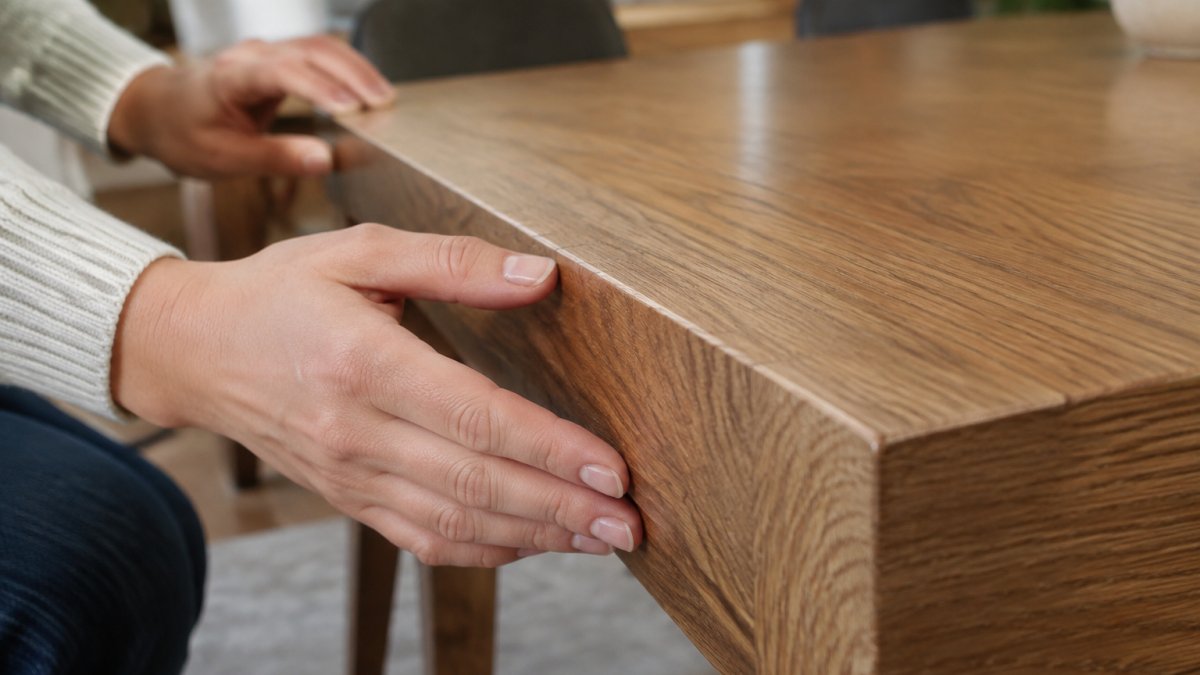
Run your fingertip along the joint. Solid wood feels continuous; veneer can feel slightly stepped where the thin layer meets the edge banding.
- Matching grain: lines that flow from top to side without a break
- Edge banding: a thin strip glued on, often a slightly different color
- Sharp corners: veneer chips at corners, solid wood dents
- Repetition: identical grain on two panels means a printed or sliced veneer
One honest limit: a well-made veneer over a solid core can fool the edge test, so check the underside and core next.
How to tell if furniture is real wood versus a lookalike
Real wood has natural variation no factory can fake convincingly: knots, color shifts, and slight differences in grain density. Laminate or printed foil repeats the same pattern every few feet and feels uniformly smooth and slightly plasticky.
Check the underside and back panel. Solid wood looks the same underneath as on top. Laminate and particleboard often show a raw, speckled core or a thin paper backing.
Examine end grain. Any exposed cut, like a table apron or stretcher, shows growth rings and porous texture on solid wood. Engineered wood shows a uniform, glued-together core.
Compare weight. Solid oak or mango is heavy and cold to the touch; MDF and particleboard feel lighter and warmer.
Look for joinery. Dovetail and visible mortise-and-tenon joints usually signal better construction than staples and cam locks.
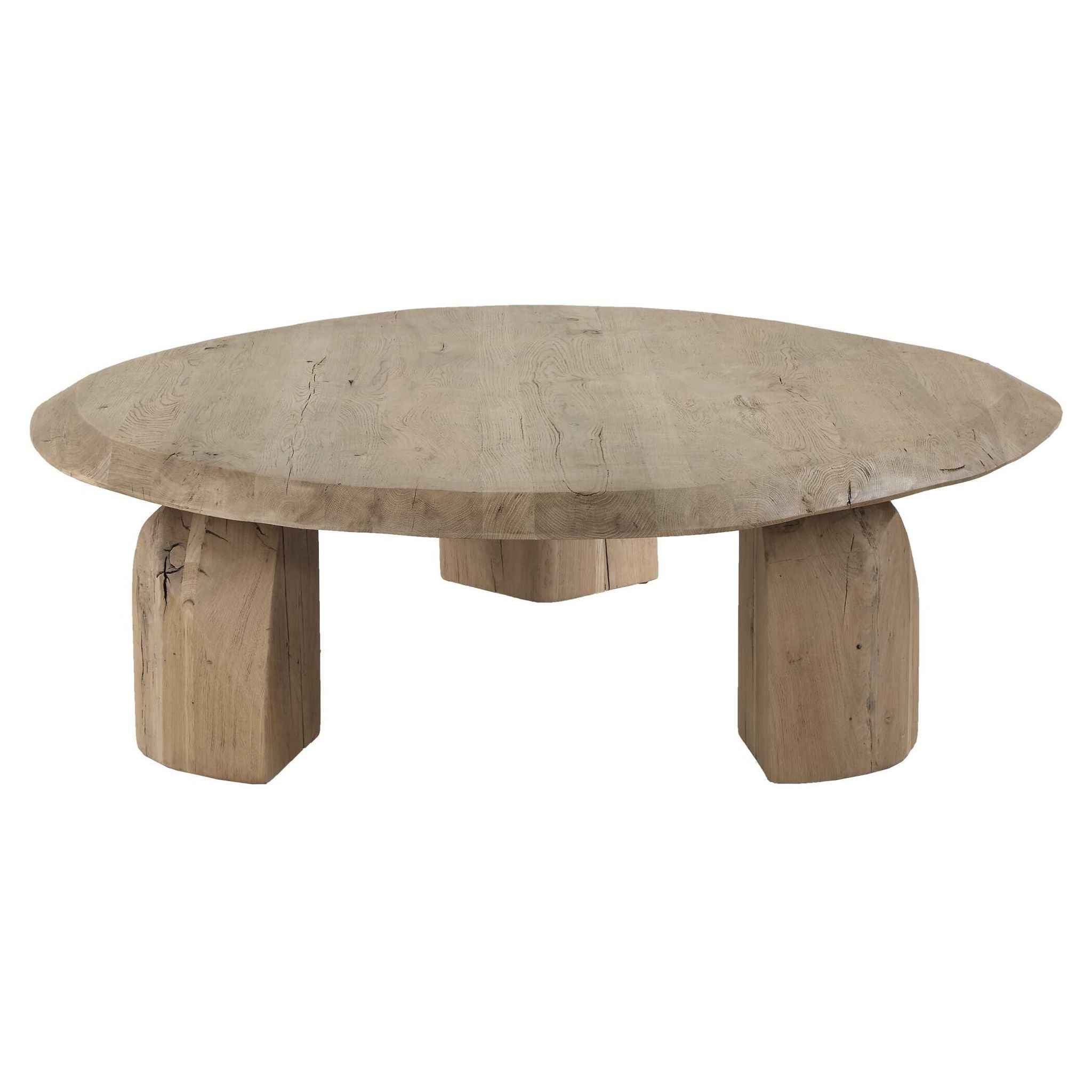
For a real example, our reclaimed oak round coffee table is built entirely from solid reclaimed oak, so you can see genuine continuous grain on a finished piece. Shopping online? Our guide on how to verify furniture quality online walks through the questions to ask before you commit.
Watch out: a seller who only photographs the top and never the underside leaves important construction details out of view. Ask for a photo of the back panel before you buy.
Engineered wood vs solid wood furniture: reading the core
The core tells you what you are actually buying. Engineered wood is made from wood fibers, particles, or thin layers glued together, plywood, MDF, and particleboard. Solid wood is cut from one piece, so its core matches its face.
| Feature | Solid wood | Veneer over solid core | Particleboard or MDF |
|---|---|---|---|
| Grain across edges | Continues around | Stops at edge strip | Printed, repeats |
| End grain | Visible growth rings | Hidden by veneer | Uniform speckled core |
| Weight | Heavy, dense | Medium | Lighter |
| Repairs | Can be sanded and refinished | Limited sanding only | Hard to repair |
| Best for | Heirloom pieces, daily use | Budget-friendly looks | Flat-pack, low-traffic rooms |
Plywood is the strongest engineered option because its crossed layers resist warping. MDF and particleboard are denser and flatter but swell if water reaches an unsealed edge.
Our advice: buy solid wood for anything you sit on, eat at, or expect to keep for a decade. Choose engineered wood for shelving, accents, and low-traffic rooms.
Furniture shopping gets a lot easier once you know what to look for, and harder once you realize how many pieces only look the part. At Furniture Depot, we stock solid mango and reclaimed oak tables built to show their grain honestly, we deliver free on orders over $499 across the GTA, and we back every purchase with a price guarantee and flexible no-interest financing. Get started with Furniture Depot and furnish your home with pieces you can inspect, trust, and keep.
Frequently Asked Questions
How can you tell solid wood from veneer?
Look at an unfinished edge, such as the underside of a tabletop or the back of a drawer front. Solid wood shows grain lines that continue from the face around the edge. Veneer shows a thin top layer over a different core, often with a visible seam or a core that looks like plywood or particleboard. Tapping the surface can also help: solid wood sounds dull and consistent, while veneer over a hollow core can sound thinner.
Is furniture with a wood veneer still good quality?
Yes, veneer can be good quality. A veneer over plywood or MDF can be stable and resist warping, and it often costs less than solid wood. The key is the core material and the construction, not the veneer alone. Check the joints, the drawer boxes, and the weight. A well-built veneer piece can outlast a poorly built solid wood one, so judge the whole piece rather than the surface.
Does solid wood furniture have knots and grain on every side?
Not always. Solid wood pieces can have knots and visible grain, but a manufacturer may choose clear, uniform boards or apply a finish that hides variation. Grain should still appear on unfinished surfaces like the underside or the inside of a drawer. If every visible surface looks identical with no natural variation, that is a sign of a printed or veneered finish rather than solid wood.


